During our last class, Alan mentioned the use of refuge in fighting alcohol addiction. I wasn't sure if he directly connected this to the issue of AA "higher power" language, but I personally found the idea interesting and thought-provoking. Refuge itself is a little flexible in its interpretation. Thanissaro Bhikkhu even mentions that each of the refuges have two different senses. On the one hand, refuge in the Buddha can be be dirrectly in the Shakyamuni figure himself, but on the other hand - and Thanissaro would say more ideally - you take refuge in Buddha in terms of awakening, your own potential for awakening. THis is like really calling upon your highest self. SO in some ways, it is like seeking external power to help, but in another sense its coming from inside.
Them there is also the use of the Dhamma - and the Sangha. Both of these have some external equivalence of power to help us, almost no matter how you interpret them.
I think just the fact that refuge is so integral to Buddhism, and rather flexible in its moment-to-moment interpretation helps keep it open to a variety of people using it in the way that they themselves find useful. At the same time, I wonder which ways of interpreting and using refuge are more effective for alcoholics themselves.
Monday, May 20, 2013

Saturday, May 11, 2013
Mindfulness, PTSD, and the Military: ethical questions and quandries
I was happy to learn of the increased efforts of the military to work with PTSD and its related increasing work with mindfulness. I am happy for the soldiers that this is showing positive results, both prior to and after the stressful conditions of combat.

 Watching the movie "Wartorn" presented such a stark and bleak look at the effects of combat, combat training, witnessing the all around effects of war. In some ways, it was hopeful in the sense that there is far more awareness nowadays of the effects, yet the trauma experienced by so many individuals puts such a strain on them and their families.
So on the one hand, I am hopeful that increased mindfulness training can help. Yet, at the same time I am a little weary of the potential manipulation of such a technique for the military's benefit.
Over a decade ago, one American ordained in the Japanese Zen tradition wrote a couple books that through the Japanese Zen schools in particular, and all Japanese Buddhist schools into a tizzy: Zen at War and Zen War Stories. The books documented Japan's use and abuse of Buddhism during the Pacific War period and its imperial expansion.
The Japanese soldiers at the time underwent Zen training, but numerous issues arise. There is evidence that some soldiers experienced a stronger dissociation with life. Eventually one Japanese general lamented in 1943, “there are none calling themselves Japanese soldiers who are attached to life. On the contrary, they all want to die…. Thus, the problem is not death, but how to accomplish our mission. What I am racking my brains about is not teaching my soldiers how to die laughing or die with peace of mind, but rather how to get them to stay alive even one more day fighting to the last.” (Zen at War, 215)
In other cases, evidence shows that meditation helped individuals commit a murder. Onumo Sho, troubled with serious anxiety over an assassination he was about to commit, decided to do zazen:
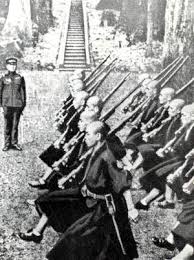
Then there is the case of Yasutani Haku'un, a Zen monk whose fervent nationalism led him to be one of many monks involved with the training of the Japanese military.

So on the one hand, I am hopeful that increased mindfulness training can help. Yet, at the same time I am a little weary of the potential manipulation of such a technique for the military's benefit.
Over a decade ago, one American ordained in the Japanese Zen tradition wrote a couple books that through the Japanese Zen schools in particular, and all Japanese Buddhist schools into a tizzy: Zen at War and Zen War Stories. The books documented Japan's use and abuse of Buddhism during the Pacific War period and its imperial expansion.
The Japanese soldiers at the time underwent Zen training, but numerous issues arise. There is evidence that some soldiers experienced a stronger dissociation with life. Eventually one Japanese general lamented in 1943, “there are none calling themselves Japanese soldiers who are attached to life. On the contrary, they all want to die…. Thus, the problem is not death, but how to accomplish our mission. What I am racking my brains about is not teaching my soldiers how to die laughing or die with peace of mind, but rather how to get them to stay alive even one more day fighting to the last.” (Zen at War, 215)
In other cases, evidence shows that meditation helped individuals commit a murder. Onumo Sho, troubled with serious anxiety over an assassination he was about to commit, decided to do zazen:
After starting my
practice of zazen I entered a state of Samadhi the likes of which I had never
experienced before. I felt my spirit
become unified, really unified, and when I opened my eyes from their
half-closed meditative position I noticed the smoke from the incense curling up
and touching the ceiling. At this point
it suddenly came to me – I would be able to carry out [the assassination] that
night.” (Zen at War, 214)
In his court testimony later, he said,
“I was primarily guided by Buddhist thought in what I did. That is to say, I believe the teachings of
Mahayana Buddhism as they presently exist in Japan are wonderful.” (Zen at War, 215)
Then there is the case of Yasutani Haku'un, a Zen monk whose fervent nationalism led him to be one of many monks involved with the training of the Japanese military.
Yasutani also provides one of the
more clear and detailed answers as to why he thinks Buddhists can kill, despite the fact
that the first precept instructs otherwise:
"What should the
attitude of disciples of the Buddha, as Mahayana bodhisattvas, be toward the
first precept that forbids the taking of life?
For example, what should be done in the case in which, in order to
remove various evil influences and benefit society, it becomes necessary to
deprive birds, insects, fish, etc. of their lives, or, on a larger scale, to
sentence extremely evil and brutal persons to death, or for the nation to
engage in total war? Those who
understand the spirit of the Mahayana precepts should be able to answer this
question immediately. That is to say, of
course one should kill, killing as many as possible. One should, fighting hard, kill everyone in
the enemy army. The reason for this is
that in order to carry [Buddhist] compassion and filial obedience through to
perfection, it is necessary to assist good and punish evil. However, in killing [the enemy] one should
swallow one’s tears, bearing in mind the truth of killing yet not killing. Failing to kill an evil man who ought to be
killed, or destroyed, would be to betray compassion and filial obedience, to
break the precept forbidding the taking of life. This is a special characteristic of the
Mahayana precepts" (Zen War Stories, 69).
(Yasutani with his student, Philip Kapleau, author of The Three Pillars of Zen)
In this quote, Yasutani presents
many ideas which lead to justification of war: a dualistic
concept of good and evil, coupled with belief in Japan’s purity and the compassion
to spread it. According to Yasutani’s
reasoning, not only does the precept allow for killing others, but it requires
“killing as many as possible” in order to keep the precept.
It is a far cry to move from PTSD related mindfulness training to the issues experienced by Japanese Buddhist military training of the Pacific War, yet in some ways it seems so easy to move down a slippery slope once some success is established. If our military finds mindfulness training leads to more effective willingness to shoot at their targets, what will happen? How will these teachings be used?
I am not saying this kind of slippery slope will happen, and I think its great if meditation can help suffering soldiers, yet I also have some serious concerns about where this could lead. So I am simply unsure how I feel about it.
movies with alcoholism themes
[spoiler alert: I give away endings in these summaries]
The Lost Weekend


This movie was not just a nice glimpse into the binge of an alcoholic, but a great portrayal of attitudes towards alcohol and alcoholism in the 1940s - as well as a nice portrait of life in 1940s New York.
The movie focused around the life of one writer's severe struggles with alcoholism and the romance that helps him find a way out. Apparently the realism of the film was quite controversial for its time. But the acting was quite good and the portrayal of one man's history of alcoholism, his methods of doing anything to get a drink despite his brother's and girlfriend's efforts to keep him away, and what happens when he starts on a binge are all quite well done. Two parts of the film I felt were a little strange were the captive scene and the end. In one scene, the protagonist, Don Burnam, falls down a staircase. While unconscious, he is taken to a ward and wakes up in a room lined with beds of other individuals with alcohol problems. They make a big deal out of the hallucination issues in that scene and one that follows. I admit I am not an expert on alcoholism, but I thought this aspect seemed a little overplayed. It felt as though symptoms of different issues were conflated here. Also, the end of the movie came extremely quick after such a long, drawn-out portrayal of the problem. Don is struggling so much with his alcoholism, he considers suicide. But his girlfriend stops him, and convinces him to pursue his life as a writer. The change comes rather suddenly, he promises to stop, the movie suddenly ends. I was left wondering if the director was implying that the problem was solved in that moment. I had a hard time being convinced myself. But, overall, the movie potrayed Don's struggles very vividly and well. I'm sure the movie provided much social benefit for the time it was produced in raising attention to alcoholism issues.
Under the Volcano
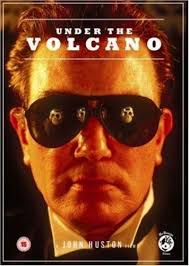
This 1984 film was based on an earlier novel of the same title. It is similar to the first movie in that it follows a very short time frame. However, whereas The Lost Weekend storyline occurs over the course of a few days, Under the Volcano traces the events of the final day-and-a-half in the life of an alcoholic. The movie takes place in Mexico around time of WWII, and the protagonist, Geoffrey Firmin is living there as a British diplomat. His wife left him a while ago. He becomes heavily drunk when he finally opens up a divorce request from her. However, the letter is rather outdated, and she arrives the next morning after extended travel to try and get back together. Its later revealed that he never opened up most of her letters. However, the effort ends up being too late as Geoffrey winds up drunk in some saloon/brothel, and angers a customer that thinks Geoffrey is about to steal his horse. He is shot to death at the end of the film, but not before a drawn-out portrayal of going through a day largely in a drunken stupor. His wife and half-brother, Hugh, have to help him undress to shower, help him shave, and do other daily chores. Geoffrey goes in and out of different degrees of drunkenness throughout the day as he finds his way towards more alcohol. He goes on a carnival ride, where children are shown picking up all the belongings he drops in the process.
 I was surprised at ultimately how little effort his family made in trying to calm his drinking habits in the film. They made some little comments every so often about putting a drink down or not drinking so much. But he ignored them and they never persisted. In the evening, Hugh joins him in drinking a bit. They seem to recognize Geoffrey's drinking problem yet don't take it very seriously. They seem to just accept that as part of who he is ... which is interesting in itself. In this sense, the movie gives a very different depiction than The Lost Weekend.
Flight
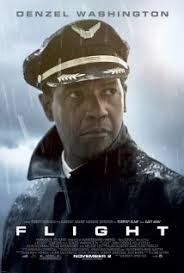
I thought this was a wonderful movie and fit perfectly into this class. The movie had a provocative storyline built around the issue of alcoholism. The captain of a plane does a daring maneuver to save the plane from crashing. 6 people die, but they say that most other pilots would not have been able to spare anyone's life. However, blood tests in the hospital reveal that the pilot, Whip Whitaker, was drunk at the time, leading to a legal issue that continues throughout the movie. In that process, we see how much of an alcoholic he really is. You see a couple times he starts to give up his drinking habits, but then he has one drink and can't stop. The girlfriend he picks up along the way starts attending AA meetings and tries to bring him along. He goes to one, but leaves and doesn't want to come back. His habits continue and the movie slowly shows how many of his family and friends he has lost due to drinking. At the very end, Whip has the opportunity to get off clean during his trial - but suddenly confesses to being an alcoholic who is drunk there and continuously drinking. He is sentanced to prison - but turns his life around there, helping other alcoholics in prison and reconnecting with his friends and family after a year of sobriety.
It is a touching story showing both the effects of alcoholism, the struggles therein, and the point at which a person turns around. The inclusion of AA meetings in the movie and the textured look at his various relationships helps provides a nice glimpse into Whip's life and how much the alcohol consumes him. But it also shows an inspiring story of change.
The Lost Weekend
This movie was not just a nice glimpse into the binge of an alcoholic, but a great portrayal of attitudes towards alcohol and alcoholism in the 1940s - as well as a nice portrait of life in 1940s New York.
The movie focused around the life of one writer's severe struggles with alcoholism and the romance that helps him find a way out. Apparently the realism of the film was quite controversial for its time. But the acting was quite good and the portrayal of one man's history of alcoholism, his methods of doing anything to get a drink despite his brother's and girlfriend's efforts to keep him away, and what happens when he starts on a binge are all quite well done. Two parts of the film I felt were a little strange were the captive scene and the end. In one scene, the protagonist, Don Burnam, falls down a staircase. While unconscious, he is taken to a ward and wakes up in a room lined with beds of other individuals with alcohol problems. They make a big deal out of the hallucination issues in that scene and one that follows. I admit I am not an expert on alcoholism, but I thought this aspect seemed a little overplayed. It felt as though symptoms of different issues were conflated here. Also, the end of the movie came extremely quick after such a long, drawn-out portrayal of the problem. Don is struggling so much with his alcoholism, he considers suicide. But his girlfriend stops him, and convinces him to pursue his life as a writer. The change comes rather suddenly, he promises to stop, the movie suddenly ends. I was left wondering if the director was implying that the problem was solved in that moment. I had a hard time being convinced myself. But, overall, the movie potrayed Don's struggles very vividly and well. I'm sure the movie provided much social benefit for the time it was produced in raising attention to alcoholism issues.
Under the Volcano
This 1984 film was based on an earlier novel of the same title. It is similar to the first movie in that it follows a very short time frame. However, whereas The Lost Weekend storyline occurs over the course of a few days, Under the Volcano traces the events of the final day-and-a-half in the life of an alcoholic. The movie takes place in Mexico around time of WWII, and the protagonist, Geoffrey Firmin is living there as a British diplomat. His wife left him a while ago. He becomes heavily drunk when he finally opens up a divorce request from her. However, the letter is rather outdated, and she arrives the next morning after extended travel to try and get back together. Its later revealed that he never opened up most of her letters. However, the effort ends up being too late as Geoffrey winds up drunk in some saloon/brothel, and angers a customer that thinks Geoffrey is about to steal his horse. He is shot to death at the end of the film, but not before a drawn-out portrayal of going through a day largely in a drunken stupor. His wife and half-brother, Hugh, have to help him undress to shower, help him shave, and do other daily chores. Geoffrey goes in and out of different degrees of drunkenness throughout the day as he finds his way towards more alcohol. He goes on a carnival ride, where children are shown picking up all the belongings he drops in the process.
Flight
I thought this was a wonderful movie and fit perfectly into this class. The movie had a provocative storyline built around the issue of alcoholism. The captain of a plane does a daring maneuver to save the plane from crashing. 6 people die, but they say that most other pilots would not have been able to spare anyone's life. However, blood tests in the hospital reveal that the pilot, Whip Whitaker, was drunk at the time, leading to a legal issue that continues throughout the movie. In that process, we see how much of an alcoholic he really is. You see a couple times he starts to give up his drinking habits, but then he has one drink and can't stop. The girlfriend he picks up along the way starts attending AA meetings and tries to bring him along. He goes to one, but leaves and doesn't want to come back. His habits continue and the movie slowly shows how many of his family and friends he has lost due to drinking. At the very end, Whip has the opportunity to get off clean during his trial - but suddenly confesses to being an alcoholic who is drunk there and continuously drinking. He is sentanced to prison - but turns his life around there, helping other alcoholics in prison and reconnecting with his friends and family after a year of sobriety.
It is a touching story showing both the effects of alcoholism, the struggles therein, and the point at which a person turns around. The inclusion of AA meetings in the movie and the textured look at his various relationships helps provides a nice glimpse into Whip's life and how much the alcohol consumes him. But it also shows an inspiring story of change.
Friday, May 10, 2013
Book Review of Chonyi Taylor’s "Enough! A Buddhist Approach to Finding Release From Addictive Patterns"
And what is the result of stress? There are some cases in which a person overcome with pain, his mind exhausted, grieves, mourns, laments, beats his breast, and exhausted, comes to search outside, ‘Who knows a way or two to stop this pain?’ I tell you, monks, that stress results either in bewilderment or in search. (AN 6:63)
This quote from the Anguttara
Nikaya exemplifies the Buddha’s description of how people deal with stress
in their lives. This stress comes from
craving, which according to Buddhism, essentially acts as an addiction. The two paths of bewilderment and search in
the quote are thus very reminiscent of the two sides of [the alcoholism chart].
Buddhism, in so many of its facets, is designed to help in recovering from addictions. Making the link to addiction recovery and
Buddhism is not new, and many books have addressed this issue. One particularly interesting account comes
from Chonyi Taylor’s Enough!: A Buddhist
Approach to Finding Release from Addictive Patterns. As a long-time practitioner ordained as a nun
by the Dalai Lama who also worked professionally as a counselor for those
dealing with serious addiction issues, Taylor draws on plenty of direct
experience from both sides of this combination.
This paper will summarize the main themes, strengths and weaknesses of
the book, before addressing the elements that I personally could use and adapt
in future chaplaincy experiences.
Taylor defines addiction early on in the volume as “a
mental habit in which there appears to be no conscious control, which gives
short-term pleasure and long-term harm, and in which our own needs override the
needs of others” (9). I think this is a
strong definition which includes three main elements. The first part regarding a habit and the apparent
lack of control is fairly common when defining addiction. Next comes a qualifier about the primacy of
short-term pleasures. I think this part
helps provide an interesting link to where she can focus much of the discussion
on Buddhism. The last part of the
definition focuses on the narrowing view towards selfish desires and the
ignorance that develops towards others.
Although Taylor does not directly mention it, these two qualifiers on
her definition direct much of the upcoming discussion in her book through their
equivalence by their association with a common two-pronged Mahayana theme of
wisdom and compassion.
The book itself gives a well-rounded look at the causes
of addiction, and how various elements of Buddhist philosophy and practice can
help free a person from such patterns. Most
of the first half of the book focuses more on the nature of addictions. Along the way, it starts by introducing some
basic meditation instruction, and then progressively more detailed exercises. Although, such exercises deal with efforts
for change in specific ways, the discussion of response and recovery becomes
more dominant at chapter six and beyond.
The particular view of Buddhism presented in this book is
highly influenced by the author’s predominantly Vajrayana background. It was interesting to read this book while
also taking a class on Buddhist tantra this semester. I read material in that class by Lama Yeshe
who is often quoted in this book.
Another of Lama Yeshe’s students, Rob Preece, author of The Psychology of Buddhist Tantra,
seemed to have heavy correspondence to Taylor’s book as well. Tantra seems to place a heavy emphasis on
well-defined motivations at the beginning of meditation practice, use of
visualization, and developing keen awareness of the effects of defilements so
as to overcome them. All of these
elements were displayed in Chonyi Taylor’s book. I also saw elements of tantra in the
descriptions of light visualization in the body, including the nine-breath
visualization pattern that acts as a common starting point in many Tibetan
meditations.
Overall, I enjoyed many aspects of this book, yet it
displayed some weaknesses as well. I
felt Taylor’s association between the mind and brain were a little too direct,
almost presented as equivalents. I don’t
want to say I have proof the mind is something completely separate from the
brain, but I am also skeptical of science that simply assumes they are the same
thing. For example, Taylor states that the
“addictive habit has become buried in the primitive part of the brain” (45). This
seems to be a narrow statement, since addiction can be patterned in neurons throughout
the brain. Moreover, cell membranes have
showed many decision making aspects occur throughout the body and not just the
brain. Neuropeptides which help enforce
addictive behaviors may be generated in the brain, but spread and carry out
their effects throughout the entire body.[1] I also felt the issue of pain was treated a
little dangerously. Although I
appreciated most of the discussion on pain, when Taylor spoke of becoming more
tolerant of pain (95), I did not feel she provided enough safeguards to make
sure that readers would not misuse this advice.
Also, I think the perspective she gave of Buddhism was not properly
identified. Although I do not have issue
with the perspective she comes from, that perspective is quite strictly from a
Tibetan Vajrayana position. She fails to
clearly identify that perspective she holds, and unfamiliar readership could be
confused at the differences between Buddhism in this book vs. some of the ideas
presented from a vipassana-dominant perspective.
Despite these rather nit-picky examples, however, there
were many things I deeply appreciated about this book. The overall tone was calm and hopeful, yet
clear and pragmatic. I could easily
imagine the writing style to be attractive to somebody coping with a serious
issue themselves, researching information for a loved-one in need, or to
someone looking to enhance their skills as a caregiver. I also personally really appreciated the
chapter focused around King Songtsen Gampo’s “Sixteen Guidelines for Life.” Anyone who has been around Buddhism for a
while or read their fair share of sutras and commentaries knows that Buddhism
is filled to the brim with various lists.
I’ve seen many, but this was the first time I saw the “Sixteen
Guidelines.” The four areas and the items
in each area provide a really well-rounded view of personal practice and
excellent daily reminders of things to work on.[2] Besides these features, I thought Taylor’s
book provided abundant examples from to assist a chaplain in working with
patients dealing with addiction issues.
The resources for helping people deal with addictions
fall into the categories of Buddhist philosophy and in the various meditation exercises.
Taylor suggests turning around the same aspects of our mind that helps create
addiction in the first place. She says
three important emphases are strong motivation, repetition, and reward. To help create new habits, she suggests
familiarizing ourselves with new habits.
She asserts that a real key is to “catch ourselves at the moment just
before we fall into the ineffective pattern” (62). I feel there are some ways
that Taylor phrased or brought up issues that would help me better deal with a
client. For example, on page 58 - just asserting that feeling good is not a
problem, but hanging onto that feeling is a problem. That equates to craving. All things, however, are impermanent and that
clinging will eventually lead to suffering – These types of ideas help provide
a starting point I could see to explore issues with a patient, where I would
otherwise not know how to enter into an issue. Another example occurs on pages
106-110, where the author lists 3 different versions to one story based on the
different types of communication that occur.
The way she outlines this can be a helpful dialog or role play to guide
a patient through.
The most helpful part of the book for me was the variety
of meditation practices. I liked the
basic outline in which she described the theoretical parts of the meditation
and then went through step-by-step with what to do for each practice. Although
I would have issues with some specific points of wording in certain places, and
I would edit some of the meditations to my own comfort level, the meditations
in this book provide an extremely solid template to follow when helping to
guide a patient through mental exercises that can systematically work with overcoming
various aspects of addictive behavior. The
meditations use a variety of different types of equanimity development, locating and exploring the trigger points that
set off an addictive behavior, various ways to deal with pain, and more. I like that the meditations Taylor provides are
very active for the mind in the sense that there is a constant activity for the
mind to be doing. I think this is
helpful for people with very serious addictions whose minds might have trouble
with simply extended periods of silence on a single object of focus. Instead, this format can provide a directed
and systematic examination.
Chonyi Taylor’s book is from a very particular Buddhist
tradition with practices inspired from her line of training, but they are
easily applicable to people from almost any religious (or non-religious)
background. The book has a good overall
structure with many helpful pointers that can provide a solid base platform
from which to build a treatment plan for patients dealing with addiction
issues.
[1]
See, for example, Candace Pert et al., “Neuropeptides
and Their Receptors: A Psychosomatic Network,” Journal of Immunology
135, no. 2 (August 1985): 820–826; Candace Pert, “The Wisdom of Receptors:
Neuropeptides, the Emotions, and Bodymind,” Advances 3, no. 3 (Summer
1986): 8–16; and Candace B. Pert, Molecules Of Emotion: The Science Behind
Mind-Body Medicine (NY: Scribner, 2003).
[2]
The sixteen guidelines are separated into four categories: how we think
(humility, patience, contentment, and delight), how we can reconnect (kindness,
honesty, gentleness, and right speech), how we can interact with compassionate
wisdom (respect, forgiveness, gratitude, and loyalty), how to find meaning in
our lives (principles, aspiration, service, and courage).
Saturday, May 4, 2013
an indigenous Equadorean Shaman's view on plants
After class I was reflecting on my conversation with this one shaman
from the Andes who recently moved to California. He gave a lecture I
attended one day, but then I continued to ask him some questions after
it ended. One plant he helped people work with was Ayuhuasca - a
powerful hallucinogenic plant. This reminded me of Jacob's comment of
playing with fire. I heard numerous stories from people there and prior
to this, that one day of working with this plant has completely cured
illnesses that no Western-trained doctor could cure - however, this
usually involved strings of powerful hallucinations, convulsing, and
vomiting. Not having a well-trained guide with someone might lead to
only bad results. Its not something that even well-trained people will
try with too much regularity. Only if used carefully and respectfully,
can one really get the strong positive results.
One other interesting comment he made - that maybe far fewer people would accept - was that there was some almost global relationship humanity had with plants. He said that different plants all had special kinds of vibrations. These vibrations were what helped put certain types of illnesses back in order with people - effectively retuning us back into the orchestra. He said that a person could have an individual relationship with a plant type, but there was also a subtle linking of a species throughout the world. He added that the way people use a plant effected this overall relationship effectiveness around the world. Therefore, he said, people have ravaged the medicinal capability of a plant like marijuana. Too many people use it without ceremony in plain recreational ways. It passed a sort of global threshold to where a formerly essential medicinal herb was, according to him, no longer of much use.
--- I've heard some different reasons for not taking drugs and alcohol. But this one was rather unique: Don't use this recreationally, because you take away from other people's opportunity to use it as medicine when they need it.
my oh my - with all the centuries-long beer drinking throughout the world, those poor hops! :P
reflection on different meditation paths and different books for addiction recovery
During class a week ago, the difference between the Visudhimagga and
the meditation instruction from the Pali canon came up. Although I
think when you really compare them side by side, this becomes extremely
apparent, this does not mean that I think either of them is necessarily a
bad or unbeneficial practice. The descriptions of jhana, mindfulness,
and concentration, do not line up at all in the paths. There are many
terms and practices mentioned in each path that are exclusive to that
path of practice. Also, whereas vipassana and samadhi are treated
integrally related in the sutras, the Visuddhismagga treats them as
different types of practices. Of course, there are also plenty of
cross-over points, and it is easy to see why they can be confused when
not giving a thorough read.
In modern traditions, we can see the sutra path play out much more in the Thai forest tradition. But for a long time in both Sri Lanka and Thailand, most monks only read the Visudhimagga path of practice and never even bothered reading most of the sutras. Although Thailand transitioned to a more sutra based practice overall, Burma and Sri Lanka still more commonly use the Visuddhimagga. In popular Western movements, we still see this influence in the styles of the Mahasi tradition and Goenka's vipassana retreats.
There are obviously many people who have benefited from those retreats, and I think that's wonderful. Different ways work for different people. However, I think the sutras are actually far more flexible in the ways you can work with different approaches diepending upon the experience in the moment. The visudhimagga presents a much more formalized step-by-step procedure of specific experiences you should have before moving on. Although, I find that specificity limiting, some people find this specificity helpful and I respect that and with them well.
Likewise, I think some of the different books on Buddhism and addiction recovery present some very different paths. You can see the training of various individuals really stand out in their writing and suggestions. But I think this is actually a good thing. All people are conditioned in different ways and addicted in different ways. To use the old Buddhist analogy, we're not all at the same part of the shore, and thus, different types of boats can be more or less useful to help get across. Its good to have some variety out there so m=people can see what really speaks to them - and what really helps them alleviate their own suffering.
Thursday, April 25, 2013
conditioned will
The subject of "free will" came up in class discussion last week. I honestly don't see the place for free will in Buddhist thought. Even when the study about cognitive evidence for free will was brought up in class, I still don't see that as evidence of "free" will. I would like to read the report for myself, but it sounded as though there was evidence of a small moment of "free will" in brain activity decisions. The thing is, however, that even those cells that make up such activity are formed from various causes and conditions. The decisions of that will are constrained by the causes and conditions of the situation. A person does not suddenly decide I will take my next step on Pluto, before coming back to Earth. Our will is not completely free. There are still certain conditions that restrict it.
This does not mean that I am advocating determinism or the idea of predetermined fatalism.
I believe the truth of action lies somewhere in between. We do have will power that influences every moment of our activity. However, all these moments of will are influenced by the conditions of that moment.
No will completely determined. No will is completely free. All will is conditioned.
The important thing in relation to Buddhism though, is we can increase the influence of our will by increasing our awareness of each moment. One of the critical types of klesas, the causes of suffering, according to Buddhism is ignorance. The way to combat ignorance is through increasing awareness. The more awareness we have the greater our power to unify thought patterns and exercise will ---- and the greater power to exercise will in skillful ways that can help reduce or even eliminate our patterns of stress and suffering. But with such awareness, we must be realistic. We must be aware of our conditions in the present moment. For each moment provides the conditions in which to act. Skillful will does not try to walk from Kansas to Pluto in one step. Skillful will puts one step in front of the other because it is aware of where it is. It is conditioned, but with greater awareness, will can use those conditions to break free from patterns of stress and suffering.
is meditation a real cure-all for anyone?
In the class, we discussed alcoholism issues in the military and PTSD. The issues are definitely linked, and the alcohol culture among current military personnel and vets is very real. However, to what extent can meditation really help someone struggling with addiction issues and PTSD. I think meditation is very good to persue - but it should be done with caution. For someone who stuggles to close their eyes at night because they cannot help but to relive their previous horrors, do we really want to suggest they close their eyes during the day and stop thinking about things? Any meditator knows that it takes time to be able to develop the concentration necessary to maintain focus on the breath or the body, or some other object of concentration - and not have some other streams of thoughts come in that we have to observe, realize they're coming in, and then bring our focus back. I think this could be good practice, but it is rather risky as well.
Meditation is mind training - and like any physical training program we have to be careful when the body isn't completely healthy. Wind sprints might be good for someone trying to get faster, but do you really suggest that for someone who might be naturally athletic, but comes in with a badly sprained ankle?
Likewise, I think we have to be careful in the types of meditation we suggest to someone who might have PTSD or other difficult symptoms due to past traumatic experiences. Meditation can be a great tool. But I think activities that offer guided meditations would be much more beneficial for a while. For example, having a guided body-scan in which new instructions are given every 20-30 seconds can help keep the mind on track, focused on the task at hand. SOme other visualizations could be helpful as well, such as a version of Thich Nhat Hanh's 4 Earth Touchings or any of a series of basic vajrayana visualizations (There are a plethera of vajrayana body-scans and light-based visualizations that could be helpful).
After practice and building up familiarity with the concentration of such practices, more time could slowly be devoted to silence, thus building up the capability to deal with these moments of darkness.
I think similar strategies could be used for those heavy into addiction cycles who have trouble with concentration. Don't start right away with too much blank quiet time. Work at the meditation, but start for a while with something guided, where there is a consistent flow of instruction. Slowly work up the concentration to be able to work with longer periods of silence.
Monday, April 22, 2013
Science of addiction
One factor relevant to the addict of any type is the
development of personal traits. Some related
long-held scientific views have undergone vast changes over the past couple
decades. The common view in the
scientific community used to be that neural patterns in the brain were
relatively fixed by a young age and that they could not change thereafter. Numerous studies since then have demolished
that theory. Scientists have since
developed the concept of neuroplasticity, essentially the ability of the brain
to change its own hardwiring. Different areas of the brain can grow and
connections that were once solid can change.
The overarching theme of these revolutions is that conscious thought and
attention can change even our long-time mental patterns. If we learn to become
more aware of those emotions and how we respond in different situations, we can
gain more control over them.
Besides just neuroscience, other areas of study have shed light on the whole-body process in forming addictive patterns. The
paths from our brains to the rest of the cells in our bodies are run by many
little chemical elements called neuropeptides, nicknamed the “molecules of
emotion” by Candace Pert, the Georgetown Medical School professor who helped
discover them.[1] According to Pert, our bodies are addicted
to emotions. Emotions are not just
psychological; they are made up of innumerable biochemical reactions.
Our hypothalamus produces an onslaught of neuropeptides every time we experience emotion. These peptides are assembled according to each emotion and sent racing throughout the body. They latch onto cells which each contain thousands of receptors for peptides. When the peptides lock into each cell, they send signals into it that ultimately create the physical sensations we feel with each emotion.
Our hypothalamus produces an onslaught of neuropeptides every time we experience emotion. These peptides are assembled according to each emotion and sent racing throughout the body. They latch onto cells which each contain thousands of receptors for peptides. When the peptides lock into each cell, they send signals into it that ultimately create the physical sensations we feel with each emotion.
A
critical juncture comes when those cells then divide, because the new cells
then have more receptors designed to receive peptides from those emotions. Nutrients and drugs such as heroin use these
same receptors. The extent of the addiction
may differ, but the fact is that the cells of our bodies help us crave those
chemicals which contain more receptors of our cells. Although we might consider
depression and anger to be negative experiences, they also provide the
emotional rush which ultimately leads to more of those emotions. Awareness of our emotions however can help
ebb the tide, and conscious effort towards desirable emotions can help us
develop productive patterns. [2]
Recent
findings even show the power that conscious thought has over our entire genetic
structure. Genes are not activated
without environmental stimuli. As H. F.
Nijout stated, “When a gene is needed, a signal from its environment, not an
emergent property of the gene itself, activates expressions of that gene.”[3] The genes of our chromosomes are covered by
proteins. When the proteins receive
external signals, they change shape and allow the genetic sequence they were
covering to be activated. No matter what
genes one might have received from their parents, conscious attention to
thoughts and feelings, as well as other factors like nutrition, can help
control which of those genes are actually activated.[4]
These various fields - neuroscience, neuropharmacology, and epigenetics - are all showing not just how addictive patterns form, but that conscious awareness to our actions can at least help alleviate such patterns. These fields still have much research to accomplish, but I think the initial implications in regards to the possibilities for mindfulness and other related forms of meditation training is very relevant and hopeful in its relation to their potential with assisting addiction recovery.
These various fields - neuroscience, neuropharmacology, and epigenetics - are all showing not just how addictive patterns form, but that conscious awareness to our actions can at least help alleviate such patterns. These fields still have much research to accomplish, but I think the initial implications in regards to the possibilities for mindfulness and other related forms of meditation training is very relevant and hopeful in its relation to their potential with assisting addiction recovery.
[1] Candace B. Pert, Molecules Of Emotion: The
Science Behind Mind-Body Medicine (NY: Scribner, 2003), 133–145.
[2] Candace Pert et al., “Neuropeptides and Their
Receptors: A Psychosomatic Network,” Journal of Immunology 135, no. 2
(August 1985): 820–826; Candace Pert, “The Wisdom of Receptors: Neuropeptides,
the Emotions, and Bodymind,” Advances 3, no. 3 (Summer 1986): 8–16.
[3] H.F. Nijhout, “Metaphores and the Roles of
Genes in Development,” Bioessays 12, no. 9 (1990): 441–446.
[4] See M. Azim Surani, “Reprogramming of Genome
Function Through Epigenetic Inheritance,” Nature 414, no. 6859 (November
1, 2001): 122–128; Wolf Reik and Jorn Walter, “Genomic Imprinting: Parental
Influence on the Genome,” Nature Reviews: Genetics 2 (2001): 21–32.
Friday, April 5, 2013
Japan and Alcoholism
Alcohol plays a large role in Japanese culture. From Karaoke bars to easy-to-access vending
machines and 7-elevens, its presence is widespread. But the modern traditions of the businessmen
help manifest it even more.
It is not hard for a person to
develop early drinking patterns in Japan. Although Japan has a drinking age of
20, it is easy for any high schooler to get alcohol. There are no laws limiting
the time or placement of alcohol sales. There
are 24-hour convenience stores like 7-Eleven and Family Mart widely available
throughout Japan. On Tokyo they are on almost every block. Both at places like
these and at local gathering places like a Karaoke bar, they will rarely card a
young person. Moreover, alcohol is
available along somewhere along most streets without any supervision in the
form of vending machines. Many vending
machines around Japan exclusively sell alcohol, so there is person around to
check the ID of buyer. When people gather for college of even high school
gatherings through their clubs and student organizations, it usually involves
plenty of alcohol as well. There is
beer and sake available are usually both consumed in large quantities the same
night. All together, there are ample opportunities for alcohol issues to
develop at young ages for people in Japan.
Alcohol is most prominent in the
life of the “salary-man,” a Japanese term for business people. It is a widespread cultural custom that a
business team work long hours together before going out as a team for food and
drinks as a nightly tradition. Most men
will not return home until midnight or later 5 or 6 days per week. There is a very hierarchical structure to the
drinking. If the boss asks you to go,
you should go. If the boss drinks, you
should all drink with him (I would say “or her” but females in positions of
business rank are still quite rare in Japan).
If you ride the train or subway home at night, it is very common to see
numerous displays of public drunkenness.
Other people will simply ignore the behavior and quietly sit or stand on
the train without paying attention.
Although, such behavior is ignored in public, it is
often detrimental to home life. It makes
most families essentially single parent households. The majority of my Japanese friends expressed
that they barely knew their father growing up because they were always asleep
before he would return home. It is also far from uncommon for families living
in rural parts of Japan to have the father work in Tokyo. He might only return home on weekends or one
weekend every month or two, depending on the situation. Although such people remain the primary
breadwinners of the family, the family structure becomes easily broken down
with two industries that work hand-in-hand: alcohol and prostitution. Even though divorce is not nearly as common
as it is in the US, on average, there is far less close of a relationship
between husbands and wives in Japan.
Sake and other spirits are popular in Japan. Beer was only introduced to Japan 100 years
ago and seems to still remain less a part of the drinking culture. However, according
to one study, at 8.2 liters per person per year, nobody in the world drinks
more spirits than the average Japanese.
Although France comes close at 7.2, both are far ahead of the third-ranked
country, Finland at 5.7 liters. The
average American, by comparison drinks 4.8 liters per year.[1]
According to the 2011 report of WHO, spirits comprise of 42% of Japanese drinks
with beer making up only 22%. The study
shows far more alcohol abuse in men than women as disorders are present in
2.25% of men to only 0.13% of women. Liver cirrhosis and alcohol related deaths
dropped considerably from 2000-2005, but are still a major problem in Japan.[2] Overall, though, due to some of the cultural
patters, alcohol problems are contained to a segment of the Japanese
population. As one can see from the
cultural patterns and statistics, it is much more an issue for men than for
women, and within males, it is much more an issue within the businessman
culture.

Subscribe to:
Posts (Atom)